
Public EV Charging: Ignitis ON's Minute-based Pricing Model Reduces Charge-Hogging and Increases Availability
The increasing number of electric vehicles (EVs) in Lithuania has brought forth various challenges in providing public charging infrastructure. One significant issue is the potential unavailability of charging stations due to charge-hogging. Charge-hogging occurs when EVs remain connected to the charging station even after reaching a full charge, preventing other EV users from accessing it. This problem is often caused by inadequate pricing structures, which incentivize EV owners to remain connected for longer than necessary. As a result, the availability and accessibility of public charging infrastructure in Lithuania are hindered by the issue of charge-hogging.
Findings of the pilot project

In light of the challenges posed by charge-hogging and the need to improve the availability and accessibility of public charging infrastructure in Lithuania, Ignitis ON charging station network, in collaboration with the Ignitis Innovation department, initiated a pilot project. The project involved a change in the pricing structure of charging stations, from a tariff based on energy consumption to one based on charging minutes. The pilot was conducted across three locations, namely Santuoku rumai, Uzupis, and Vingriai, over a period of three months, starting in December 2022. The results obtained from the new pricing model were compared with those from the previous pricing model based on energy consumption.
Upon conducting an analysis of charging session data, it was observed that customers were not particularly sensitive to the pricing change, as the total number of charging sessions remained relatively constant across all three locations. However, when analyzing the charging session data by charging type, a notable difference was observed. Specifically, DC-based charging types, such as Chademo and CCS, experienced an approximate 5% increase in the number of sessions. In contrast, AC-based slow charging types saw a reduction of approximately 14% in the number of charging sessions, while capturing 40% higher revenue.
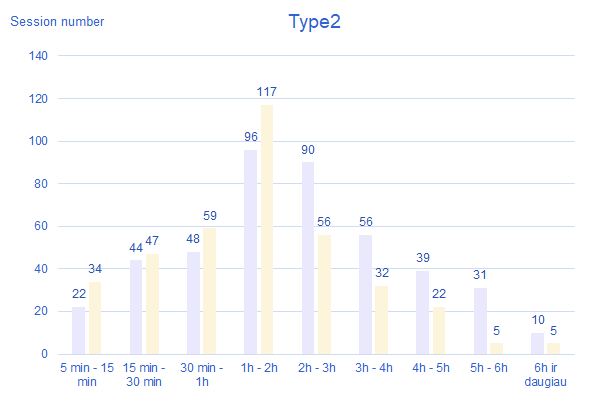
Further analysis of the charging session data revealed that, while the longest session durations remained consistent across all charger types, the average session durations exhibited a positive response to the pricing change. For fast DC-connectors, specifically Chademo and CCS, the average session duration decreased marginally by 3% and 14%, respectively. However, the most significant difference was observed for Type2 chargers, where the average session duration decreased by 45 minutes, representing a 25% change. The new pricing structure appeared to incentivize customers to charge their EVs in shorter sessions, resulting in a significant reduction in the number of longer charging sessions. This change in customer behavior was most noticeable for Type2 chargers, although it was also observed for Chademo and CCS chargers

Summary
The findings of the pilot project suggest that the minute-based pricing model positively impacts customer behavior, resulting in a greater tendency to choose shorter charging sessions over longer ones. This change in behavior, in turn, contributes to increased availability of chargers and a reduction in the charge-hogging effect. While longer charging sessions were not entirely eliminated, the new pricing model penalizes such sessions according to their duration, leading to a higher revenue yield across all charger types.
Want to know more? Contact our modelling expert Matas Dijokas – matas.dijokas@ignitis.lt
