Sodium-Ion Batteries: Advancements, Applications, and the Future of Energy Storage
Why Sodium-Ion Batteries Are Back in the Spotlight
On April 27, Contemporary Amperex Technology Co. (CATL), the world’s largest manufacturer of electric vehicle and energy storage batteries, announced a three-year, 60 GWh sodium-ion battery supply agreement. To put that figure into perspective, 60 GWh is enough energy to power approximately 5 million homes for a day.
Although sodium is one of the most abundant elements on Earth, sodium-ion batteries were largely overlooked after lithium-ion technology emerged as the industry standard in the 1990s due to its superior energy density. However, due to the dramatic growth in demand for stored energy in recent years as well as concerns over the lithium supply chain, sodium-ion batteries are gaining attention as a promising substitute for the widely used lithium-ion batteries in certain use cases, like grid-scale energy storage.
Sodium-ion batteries operate on the same fundamental charge and discharge principles as lithium-ion batteries making them compatible with much of the existing manufacturing infrastructure and energy storage systems already in use today and as production ramps up, sodium-ion battery costs are falling rapidly.
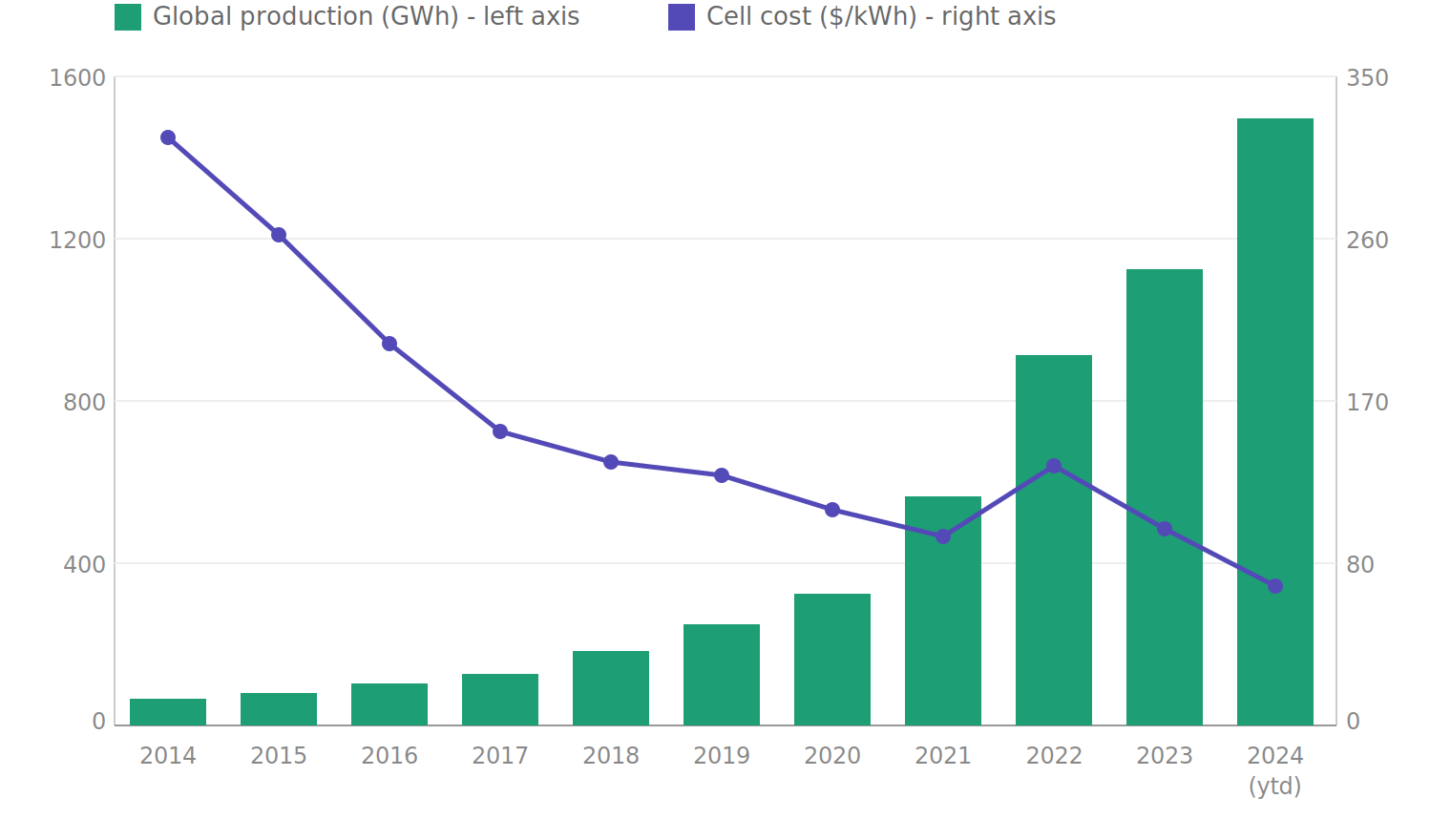
Figure 1. Sodium-ion battery global production vs cost: The Sodium ion Batteries: A Complementary Technology to Lithium ion Batteries – MMTA
Key Advantages Of Sodium-Ion Batteries
Sodium-ion batteries offer several advantages that make them an attractive option for certain energy storage applications. Sodium is an abundant and inexpensive element, reducing concerns over resource scarcity and helping diversify battery supply chains that are currently concentrated among a small number of countries. They also perform well across a wide range of temperatures and are generally considered safer due to their lower risk of thermal runaway. As manufacturing scales up, sodium-ion batteries could become increasingly cost competitive, particularly in stationary applications where energy density is less critical.
Current Limitations
While sodium-ion battery technology is advancing rapidly, it is unlikely to replace lithium-ion systems across all applications due to inherent differences in chemistry. Instead, sodium-ion batteries are increasingly viewed as a complementary technology, with lithium-ion expected to remain dominant in applications where high energy density is critical.
As a result of lower energy density, sodium-ion batteries are generally larger and heavier for the same stored energy capacity. This limits their suitability for applications where size and weight are important, such as high-performance electric vehicles and portable electronics. The technology also has a less mature supply chain and fewer large-scale manufacturing facilities compared with lithium-ion systems, which can affect scalability in the near term.
In addition, sodium-ion batteries typically have a shorter cycle life than lithium-ion batteries, meaning their capacity and performance may degrade more quickly over repeated charge and discharge cycles. However, these limitations are less significant in stationary storage applications, where footprint constraints are lower and systems are designed for long-duration operation rather than compactness.
Sodium-ion vs Lithium-ion Comparison
The table below summarizes the key trade-offs between sodium and lithium-ion batteries across major performance and economic metrics.
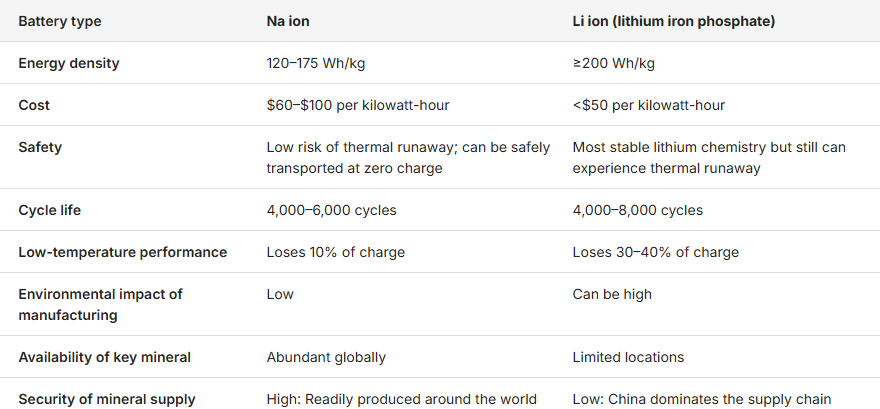
Figure 2: Sodium-ion vs Lithium-ion battery comparison: Sodium-ion batteries: Should we believe the hype?
Sodium-ion Batteries in Renewable Energy Storage
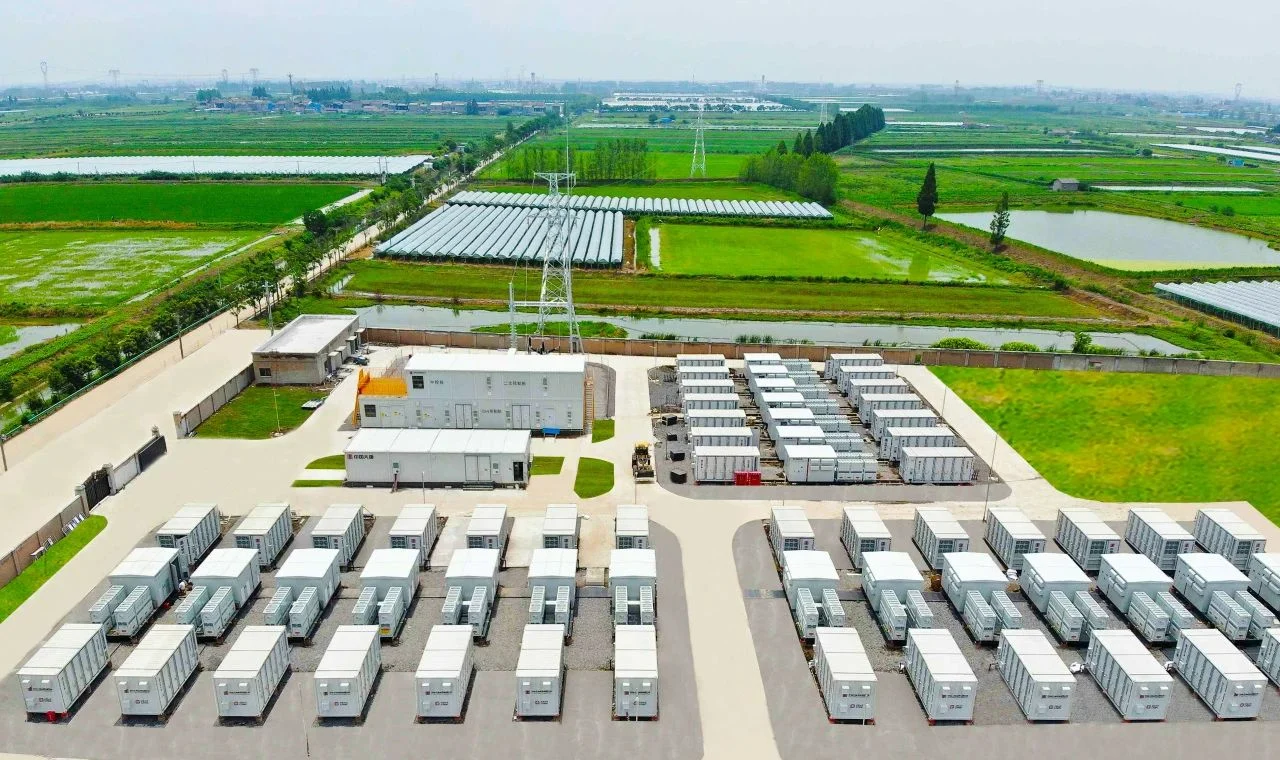
Battery energy storage systems (BESS) are a critical part of the viability of renewable energies such as solar and wind. They allow the storage of excess energy during non-peak consumption hours and while the sun or wind is available and the release of this energy when it is needed. Sodium-ion batteries could be a great alternative to lithium in BESS’s because of their increase safety which reduces the risks of operation and better performance in extreme temperatures meaning energy-consuming cooling or heating systems can be relaxed. The lower energy density of sodium-ion batteries is less significant in stationary applications, where systems are housed in dedicated containers and footprint constraints are relatively modest. As manufacturing scales, sodium-ion batteries could become a cost-effective alternative for battery energy storage systems (BESS), improving the economics of renewable energy projects.
Battery Storage Cost Estimator
CAPEX comparison — sodium-ion vs lithium LFP, European market
Estimates are illustrative and intended to show relative cost trends, not project-specific pricing.
Early Adopters of Sodium-ion Batteries
- In 2026, CATL secured the world’s largest sodium-ion battery order a 60 GWh, three-year supply agreement and has since partnered with automaker Changan to launch the world’s first mass-production sodium-ion passenger vehicle: CATL secures world’s largest sodium-ion battery order with 60 GWh deal, CATL and CHANGAN Launch World’s First Mass-Production Sodium-Ion Passenger Vehicle
- A 200 MW/400 MWh battery energy storage system in China became one of the first large-scale deployments to combine lithium-ion and sodium-ion cells in a single installation: Large-scale hybrid lithium-sodium-ion BESS comes online in China
- In Europe, German intralogistics company Jungheinrich launched field trials of sodium-ion batteries in industrial forklift trucks in May 2026: Jungheinrich launches field trials with sodium-ion batteries at selected customer sites
Looking Ahead
Sodium-ion batteries are best understood as a complementary technology rather than a direct replacement for lithium-ion systems. While lithium-ion will continue to dominate high energy density applications, sodium-ion is likely to gain traction in stationary storage due to its cost, safety, and material advantages, supporting the broader deployment of renewable energy systems.